
Overview
More than 10 million Americans suffer from TMJ disorders, making these painful jaw conditions surprisingly common. Although they both affect men and women, the majority of those seeking treatment are women in their childbearing years, according to the TMJ Association, a patient advocacy organization. Despite their prevalence, these disorders aren’t particularly well understood, even by the medical community.
What is a TMJ Disorder?
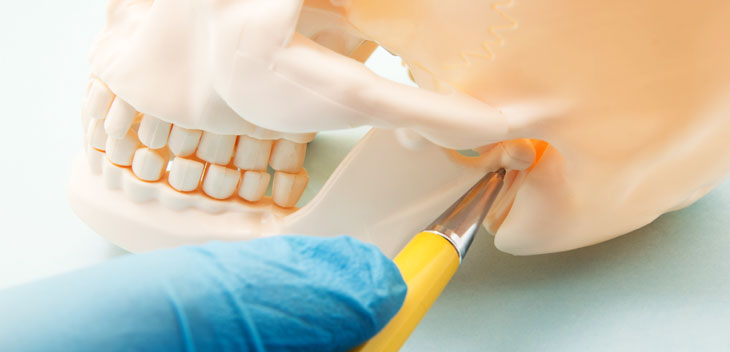
TMJ disorders are characterized by pain or dysfunction in and around the jaw. These can be issues with the jaw itself or the muscles surrounding it.
TMJ stands for temporomandibular joint. Located at the base of the skull, this is one of the most complex joints in the body. It connects the upper and lower parts of the jaw and has three distinct components: the ball (condyle), the socket (glenoid fossa), and the fibrous disc, which sits between them. Not only does it open and close like a hinge, the TMJ also allows the jaw to slide forward and backward as well as from side to side, ideally enabling it to perform all its necessary functions with ease including chewing, talking and yawning.
Although the term TMJ is frequently used to describe the set of conditions, most dentists refer to these issues as TMJ disorders or temporomandibular joint disorder (TMD).
Causes of TMJ Disorders
Many factors may contribute to these conditions, including degenerative joint diseases, hormonal reactions, stress, genetics, and trauma to the neck or jaw. Although your dentist may be able to tell you why you have certain symptoms, the root cause may not be quite so easy to determine. Symptoms may arise with no clear reason.
Explore the causes of TMD in more detail here.
Symptoms and Diagnosis of TMJ Disorders
There is a wide range of symptoms associated with temporomandibular joint disorders. The most common include: jaw pain (on either side), jaw stiffness, and a clicking or popping sound when moving the jaw. Headaches and ear pain can also be indicators.
According to the National Institutes of Health, there is no standard test available to accurately diagnose TMJ disorders. So in addition to seeing your dentist, you may also want to check in with your doctor to rule out conditions with similar symptoms such as sinus and ear infections as well as nerve-related facial pain.
Find out more about the symptoms of TMJ disorders here.
Treatment options for TMJ Disorders
Because most jaw joint and muscle pain is temporary, experts suggest beginning with the most conservative and least-invasive forms of treatment. These include over-the-counter pain relief as well as self-care practices like applying ice packs and eating soft food. Some dentists and physicians may recommend a bite guard. Botox is also being researched as a potential treatment for chronic TMJ disorders.
Get the scoop on all treatment options and solutions for TMJ disorders here.
TMJ often responds to at-home care and typically more aggressive treatments like surgery aren’t needed. Talk to your dentist or doctor to figure out what course of action is best for you.
Experiencing tooth or jaw pain? Dentistry.com can help you find a dentist near you.
Medically reviewed by Dr. Natalie Pennington, DDS, January 2019